
Summary
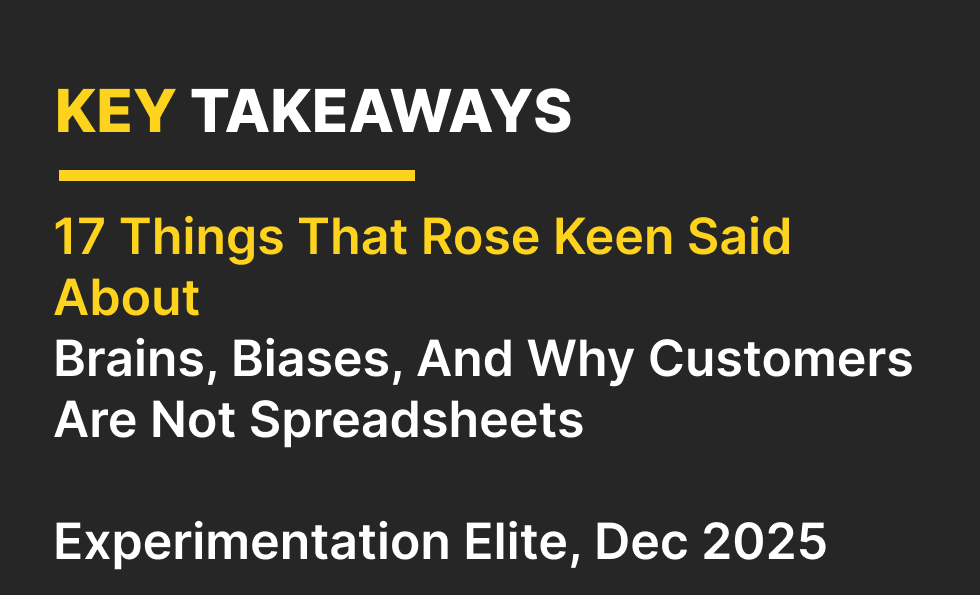
Abi’s takeaway carousel from Rose Keen’s Experimentation Elite talk, covering behavioural science, subconscious decision-making, cognitive bias and why experiments need to design for brains, not dashboards.
Description
This carousel captures Abi’s key takeaways from Rose Keen’s Experimentation Elite talk on behavioural science, cognitive bias and how people really make decisions.
The central message is that most decisions are not as rational as marketers, CRO teams and dashboards would like to believe. The carousel uses the Booba/Kiki effect to show how quickly the brain makes meaning before logic has even found its shoes. It then challenges the assumption that customers move through decisions through reasoned, conscious evaluation, arguing instead that much of what influences behaviour is subconscious, emotional and context-dependent.
Abi pulls out Rose’s B.R.A.I.N.S model as a practical way to remember six behavioural forces: Bandwagon, Reciprocity, Anchoring, Impressions, Now Picture It, and Scarcity. The carousel is careful to frame behavioural science as understanding rather than manipulation: it is not hypnosis, mind control or Jedi tricks. It is about designing experiences that work with how people actually decide, while still asking whether the design is good for the customer.
The strongest thread is restraint. Biases are already happening, but using them badly damages trust. Popularity, reciprocity, anchoring, memorable moments, concrete language and scarcity can all shape behaviour, but if they become fake, manipulative or lazy, they stop being useful and start becoming nonsense in a shiny conversion hat.
Topics
-
Why most customer decisions are not purely rational
-
The Booba/Kiki effect and instinctive meaning-making
-
Why logic often arrives after the decision
-
Behavioural science as understanding, not manipulation
-
The B.R.A.I.N.S model: Bandwagon, Reciprocity, Anchoring, Impressions, Now Picture It, Scarcity
-
Why popularity can be persuasive
-
How reciprocity affects behaviour
-
How anchoring changes perceived value
-
Why people remember emotional peaks and endings
-
Why concrete language is easier to picture and remember
-
Why scarcity works, and why fake scarcity erodes trust
Best for
CRO practitioners, UX researchers, experimentation leads, marketers, product teams, behavioural science practitioners, content designers
Background
This piece sits alongside Abi’s wider work on UX, experimentation and customer understanding because it challenges one of the industry’s laziest assumptions: that people behave rationally just because dashboards make them look tidy. Better experiments need to account for how people actually decide, including instinct, context, emotion, memory, perceived value and trust.
It also connects to the Corpus view that trust is damaged when persuasion outruns reality. Behavioural science can help teams design clearer, more effective experiences, but only when it is grounded in evidence and used responsibly. If the tactic breaks trust, it is not clever optimisation. It is just a more elaborate way to lose credibility.

About The Author: Abi Hough
Founder UU3 / WeAreCorpus
Abi Hough is the founder of UU3 and WeAreCorpus. Through UU3, she works across UX research, optimisation, audits and digital strategy. Through Corpus, she explores the upstream web: the trust, proof, signals and contradictions that shape how humans and machines understand organisations before anyone reaches a website.
Recent Comments