
Summary
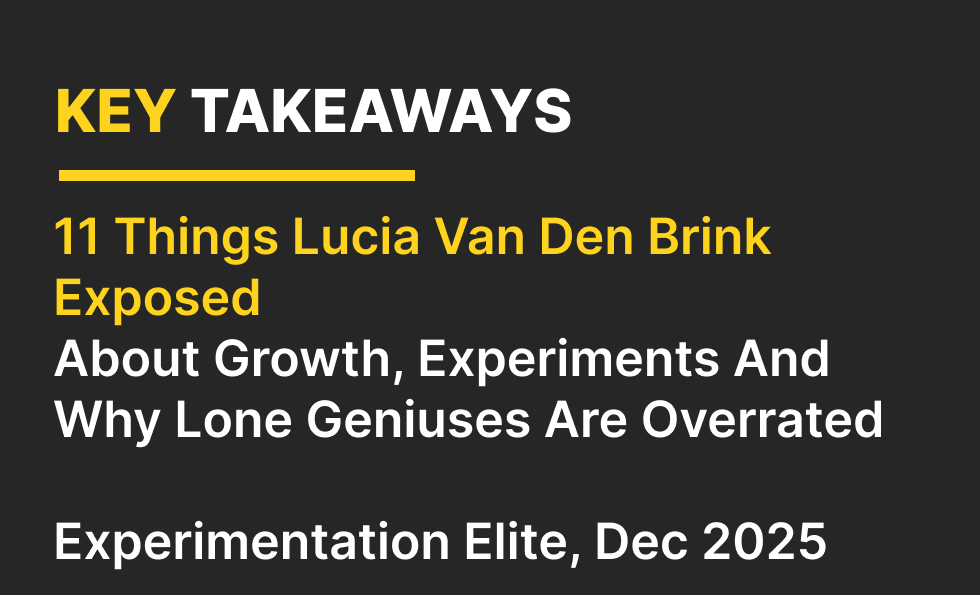
Abi’s takeaway carousel from Lucia van den Brink’s Experimentation Elite talk, covering why experimentation programmes need cognitive diversity, psychological safety, better collaboration and more varied sources of ideas.
Description
This carousel captures Abi’s key takeaways from Lucia van den Brink’s Experimentation Elite talk on experimentation, growth and the collaboration bonus.
The core argument is that some of the best experiment ideas will never come from the CRO team alone. Even when a programme looks healthy on paper, with weekly experiments, positive ROI and experimentation close to product, it can still hit a ceiling if the same people keep generating the same kinds of ideas. The carousel uses examples including YouTube’s left-handed upload issue to show how problems can be missed when everyone looks at the system from the same angle.
Abi pulls out the deeper lesson: more perspectives can lead to more winning experiments, but only when psychological safety exists. Collaboration is not just inviting more people to a meeting. It means designing deliberately for cognitive diversity, protecting uncomfortable ideas, using silent ideation before group discussion, and measuring where ideas actually come from.
The result is a practical reminder that experimentation maturity is not just about tools, velocity or process. It is about whether the organisation has enough trust, safety and perspective to find the ideas it would otherwise miss.
Topics
-
Why experimentation programmes can plateau despite looking healthy
-
The danger of relying on one CRO lead or one dominant source of ideas
-
Why unexpected roles often generate valuable experiment ideas
-
The link between multiple contributors and stronger experiment outcomes
-
Why psychological safety matters before collaboration can work
-
How workshops fail when people only say the safest thing
-
Why silent ideation can protect weird but valuable ideas
-
Why quantity creates optionality rather than chaos
-
Why experimentation culture cannot be outsourced
-
How to measure where ideas actually come from
-
Why growth often hides in conversations teams are not having
Best for
Experimentation, CRO, growth, experimentation culture, cognitive diversity, psychological safety, collaboration, ideation, UX research, product teams, organisational learning
Background
This piece sits alongside Abi’s wider work on experimentation, UX and organisational clarity because it focuses on the system around the work, not just the tests themselves. Better experimentation does not come from one clever person having better ideas. It comes from creating the conditions where different perspectives can surface, survive, and be tested properly.
It also connects to the Corpus view that trust is operational. If people do not feel safe enough to say the weird, inconvenient or unfashionable thing, the organisation loses evidence before the experiment even exists. The result is not just weaker collaboration. It is a narrower version of reality, dressed up as strategy

About The Author: Abi Hough
Founder UU3 / WeAreCorpus
Abi Hough is the founder of UU3 and WeAreCorpus. Through UU3, she works across UX research, optimisation, audits and digital strategy. Through Corpus, she explores the upstream web: the trust, proof, signals and contradictions that shape how humans and machines understand organisations before anyone reaches a website.
Recent Comments