
Summary
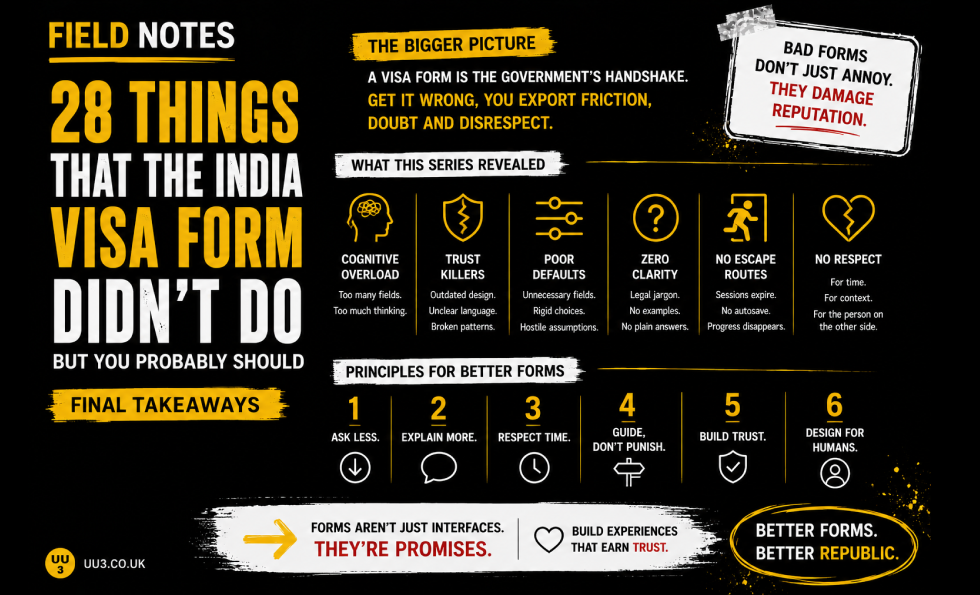
Abi’s field note on what the India visa form gets wrong, turning one painful form experience into 28 practical lessons on trust, accessibility, validation, progress, cognitive load, error recovery and form design.
Description
This field note turns Abi’s experience with the India visa form into a practical checklist of what complex forms should do better.
Across 28 points, the carousel covers the basics that too many forms still get wrong: trust indicators, page hierarchy, progress signposting, upfront expectations, mandatory and optional fields, accessible captchas, appropriate dropdowns, helpful guidance, clear field labels, real-time validation, save functionality, logical progression, inclusive options, sensible input types, grouping, consistency, character limits, data patterns, prefilling, system error recovery and proximity of related actions.
The piece is especially useful because it treats form design as a trust and comprehension problem, not just a layout problem. When a form asks for sensitive information, users need clarity, reassurance, recovery paths and confidence that the system knows what it is doing. Without that, the interface becomes a stress machine with fields attached.
Topics
-
Trust and security signals for sensitive forms
-
Page hierarchy, progress indicators and expectation-setting
-
Mandatory vs optional fields
-
Accessible captcha use and fallback options
-
Dropdowns, dialogues, tooltips and help content
-
Date pickers, field labels and input clarity
-
Error handling, validation and formatting
-
Conditional logic, saving progress and system status
-
Cognitive load, navigation and editing
-
Diversity, inclusion and sensitive questions
-
Input types, grouping, consistency and character limits
-
System error recovery and proximity of related actions
Best for
UX designers, product teams, form owners, service designers, accessibility specialists, government digital teams, CRO practitioners, and anyone responsible for long, complex or high-stakes forms.
Background
This piece sits alongside Abi’s wider work on UX, usability and trust because it shows how small interface decisions can create large confidence failures. A complex form is not just a sequence of fields. It is a promise that the organisation can handle sensitive information clearly, safely and competently.
It also connects to the Corpus view that trust breaks when claims, reality, proof and interface behaviour do not line up. In this case, the form itself becomes the evidence. If the experience is confusing, inaccessible, inconsistent or hard to recover from, the user learns something about the organisation long before they finish the task.

About The Author: Abi Hough
Founder UU3 / WeAreCorpus
Abi Hough is the founder of UU3 and WeAreCorpus. Through UU3, she works across UX research, optimisation, audits and digital strategy. Through Corpus, she explores the upstream web: the trust, proof, signals and contradictions that shape how humans and machines understand organisations before anyone reaches a website.
Recent Comments