
Summary
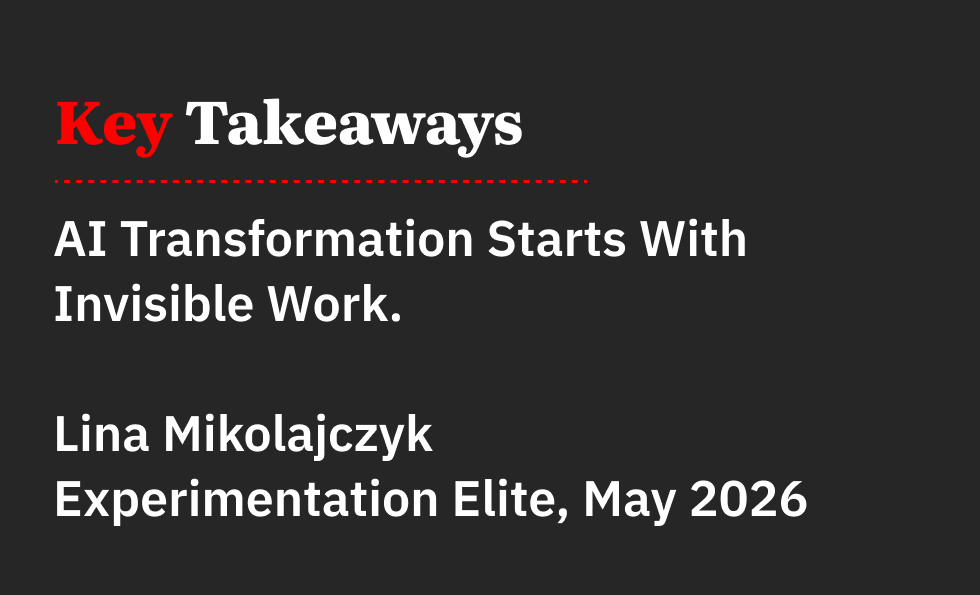
Abi’s key takeaway from Lina Mikolajczyk’s Experimentation Elite talk: successful AI transformation does not start with tools, platforms, chatbots or transformation theatre. It starts by finding the invisible work nobody measures, putting a cost against it, and proving where AI can create value in small, practical, defensible ways.
Description
In this takeaway piece, Abi reflects on Lina Mikolajczyk’s argument that AI transformation should begin with the boring work hiding in plain sight: reporting, rekeying, note-taking, brief writing, spreadsheet orchestration and all the manual sludge that keeps businesses moving badly. The central point is simple but frequently ignored: the tool is not the strategy, and the deck is not the strategy either.
Rather than starting with a platform, model or chatbot, Lina’s approach starts by costing the work first. She used scrappy evidence: five days, around 50 people, shared task categories, hours mapped to salary cost, and estimated automation potential. That kind of rough-but-useful data made hidden bottlenecks visible and turned vague AI enthusiasm into something a board could actually defend.
The piece also pushes into the uncomfortable human side of AI adoption. Saved time is not neutral. It can become capacity, or it can become cuts. The spreadsheet does not decide that: leadership does. Abi highlights why AI transformation needs a people plan, why resistance should be treated as data, and why adoption has to be designed rather than wished into existence by people waving shiny tools around in a meeting room like cursed corporate maracas.
The practical takeaway is that useful AI work is usually less glamorous than the hype suggests: talk to the people doing the work, map the invisible tasks, attach time and cost, pick small internal use cases, publish the numbers, and learn where the risk is containable before throwing AI into customer-facing spaces with a brass band and a legal headache.
Topics
-
AI transformation
-
Invisible work
-
Internal workflow mapping
-
Automation opportunity discovery
-
Business case creation
-
Costing time and manual work
-
Scrappy evidence over executive anecdote
-
Internal AI use cases
-
Adoption planning
-
Human impact of automation
-
Resistance as data
-
AI governance and leadership decisions
-
Evidence-led transformation
-
Operational clarity
-
People-centred AI change
Best for
AI leads, transformation teams, experimentation practitioners, operations teams, product leaders, UX researchers, digital strategists, business analysts, and anyone currently being asked to “do something with AI” without first asking what work is actually happening under the floorboards.
Background
This piece was created from Abi’s main takeaway after Lina Mikolajczyk’s Experimentation Elite talk. It sits well within the Key Takeaways category because it translates a conference talk into a practical, decision-useful summary for people who could not be in the room.
It also connects strongly to Abi’s wider work on UX, experimentation and upstream optimisation. The argument is not “buy AI”. It is “understand the work before you automate it.” That means identifying hidden labour, exposing operational friction, measuring the cost of manual work, and deciding what should change before a tool is allowed anywhere near the steering wheel.
From a Corpus perspective, this is also a useful example of Reality before Model. The AI opportunity does not live in the tool demo. It lives in the operational truth: what people actually do, where time leaks, what work is duplicated, what judgement still matters, and what leadership intends to do with any time saved.

About The Author: Abi Hough
Founder UU3 / WeAreCorpus
Abi Hough is the founder of UU3 and WeAreCorpus. Through UU3, she works across UX research, optimisation, audits and digital strategy. Through Corpus, she explores the upstream web: the trust, proof, signals and contradictions that shape how humans and machines understand organisations before anyone reaches a website.
Recent Comments