
Summary
A UX teardown of the first page of the Indian visa form, covering missing progress indicators, inaccessible captchas, long dropdowns, date pickers and validation chaos.
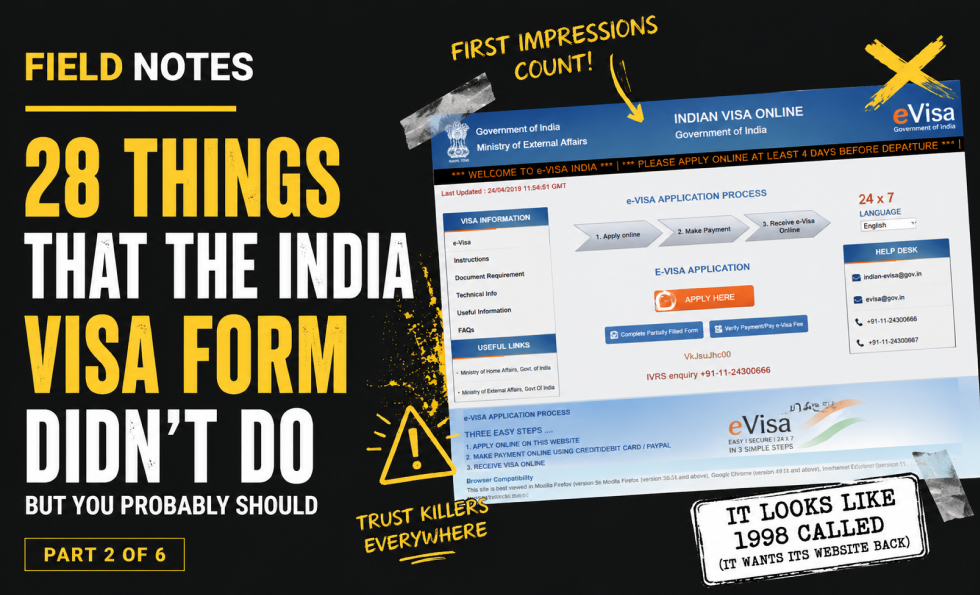
Part two takes us into the first page of the actual application form.
This is where the user should be given confidence. They should know how long the process is likely to take, what documents they need, what information they should have ready, and what will happen next.
Instead, there is no indication of how many steps the form has. Important information about documents and photo requirements appears after the form rather than before it. Every field is marked with an asterisk, creating visual clutter where one clear sentence would do. The captcha has no accessible alternative. Long country and port dropdowns are not searchable. Date of birth uses an intrusive calendar picker. Email is labelled “Email ID,” because apparently clarity had other plans.
Then the real fun begins.
A failed captcha causes selections to disappear. Visa service choices are lost. The port of arrival is lost. Error messages become inconsistent. The user is forced to redo work because the system cannot preserve state.
This is where form friction becomes form hostility.
The problem is not one bad field. It is the accumulation: missing orientation, inaccessible controls, unnecessary interruptions, weak labels, poor validation, and system behaviour that punishes the user for errors they may not have caused.
Key field notes
-
Tell users how many steps there are and what they need before they begin.
-
Do not hide document requirements below the form.
-
Long dropdowns should be searchable.
-
Do not use calendar pickers for dates of birth.
-
Captchas need accessible alternatives.
-
Failed validation should never delete completed user input.
-
Dialogues should not interrupt users to confirm the bleeding obvious.
Best for
Form UX, accessibility, validation, error prevention, progress indicators, dropdown design.
Background
This piece sits alongside Abi’s wider work on UX, usability and trust because it shows how small interface decisions can create large confidence failures. A complex form is not just a sequence of fields. It is a promise that the organisation can handle sensitive information clearly, safely and competently.
The India visa form is especially useful as a field note because the stakes are high. Users are not casually browsing. They are trying to complete an official task, avoid mistakes, protect personal information and understand what will happen next. Every unclear label, broken interaction, missing explanation or failed recovery path adds doubt.
It also connects to the Corpus view that trust breaks when claims, reality, proof and interface behaviour do not line up. In this case, the form itself becomes the evidence. If the experience is confusing, inaccessible, inconsistent or hard to recover from, the user learns something about the organisation long before they finish the task.
This second post looks at the first page of the form itself: missing progress cues, inaccessible captcha patterns, long dropdowns, intrusive date pickers and validation behaviour that makes the user redo work.

About The Author: Abi Hough
Founder UU3 / WeAreCorpus
Abi Hough is the founder of UU3 and WeAreCorpus. Through UU3, she works across UX research, optimisation, audits and digital strategy. Through Corpus, she explores the upstream web: the trust, proof, signals and contradictions that shape how humans and machines understand organisations before anyone reaches a website.
Recent Comments